

Signatera™ - Molecular Residual Disease (MRD) assay
Signatera™ is a tool for the effective monitoring of immunotherapy. It is a highly sensitive and personalised molecular residual disease (MRD) assay, using circulating tumor DNA (ctDNA), designed individually for each patient after cancer surgery to help identify relapse earlier.
The American company Natera developed the test that gained the status of a breakthrough therapy from the FDA.
Signatera™ is the first tumor-specific assay. The effectiveness in the field of diagnosis has been clinically confirmed at all stages of treatment.
What is Signatera™?
Signatera™ is a blood ctDNA test that is personalised to a patient's cancer fingerprint to monitor the molecular residual disease (MRD). MRD is the presence of small traces of cancer in the blood, such as ctDNA or microscopic fragments of tumor DNA.
Signatera™ gives us knowledge that helps answer critical questions:
- Is there any cancer left in the body?
- Is additional treatment beneficial?
- Does the treatment work?
Assay personalised for each patient
Each person's cancer is as unique as a fingerprint. Signatera is a blood test that is personalised to each patient's set of tumor mutations and can identify earlier than traditional tools whether cancer is still present.
- A one-time blood and tissue analysis allows to determine the unique set of patient's cancer mutations
- Signatera™ is made to order and personalized for the patient
- Signatera™ detects an increase or decrease of ctDNA whenever ordered as part of a routine blood test.
When to use Signatera™?
Although immunotherapy constitutes a new and revolutionary cancer treatment, not all patients respond to this type of therapy. Both the patient and their doctor should know as soon as possible whether immunotherapy is effective.
Signatera™ is a personalised cancer monitoring assay for patients who are currently taking or considering using immune checkpoint inhibitors.
Signatera™ test identifies patients who do not respond to immunotherapy as well as long-term responders who have achieved sustained clinical benefits with immunotherapy.
These results can be exceptionally helpful when deciding on treatment plans.
Signatera™ has been approved and validated for many types of cancer:
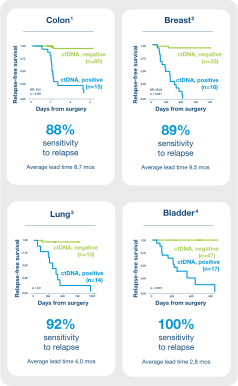
1. Reinert T, Henriksen TV, Christensen E, et al. Analysis of Plasma Cell-Free DNA by Ultradeep Sequencing in Patients With Stages I to III Colorectal Cancer. JAMA Oncol. 2019. 2. Coombes RC, Page K, Salari R, et al. Personalized Detection of Circulating Tumor DNA Antedates Breast Cancer Metastatic Recurrence. Clin Cancer Res . 2019;25(14):4255–4263. 3. Abbosh C, Birkbak NJ, Wilson GA, et al. Phylogenetic ctDNA analysis depicts early-stage lung cancer evolution. Nature. 2017;545(7655):446–451. 4. Christensen E, Birkenkamp-Demtroder K, Sethi H, et al. Early Detection of Metastatic Relapse and Monitoring of Therapeutic Efficacy by Ultra-Deep Sequencing of Plasma Cell-Free DNA in Patients With Urothelial Bladder Carcinoma. J Clin Oncol. 2019;37(18):1547–1557.
When MRD assessment can be used?
Adjuvant setting:
Use Signatera™ after surgery to evaluate the need for adjuvant chemotherapy and inform when to reduce treatment.
Surveillance setting:
Use Signatera™ alongside CEA to detect recurrence earlier while it may still be resectable.
Frequently Asked Questions
How is Signatera™ different from current biomarker tests?
Unlike other ctDNA assays, Signatera™ is designed to accurately detect MRD (i.e., not designed for early cancer screening nor for identifying actionable mutations for therapy selection). Instead, Signatera™ is customized for each patient’s unique tumor signature to optimize sensitivity and specificity for accurate MRD assessment.
What information does the test provide? A positive test result indicates the presence of ctDNA in blood. An increase in the ctDNA level indicates a lower likelihood of response to the current treatment. The reduction in ctDNA levels indicates that cancer may be responsive to current immunotherapy, which may translate into favorable treatment outcomes. A negative Signatera™ test means that no ctDNA has been detected in the blood, and the data indicate that there is a high probability of a favorable or sustained response to immunotherapy.
When will Signatera™ test results be available?
Designing your first Signatera™ test: for your first order, it will take 4 weeks to design your customised Signatera™ test.
Availability of results after Signatera™ test is designed: test results will be available to the physician after 1-2 weeks.